The world is tightening into a dangerous squeeze. On one side stands the United States, increasingly inward-looking and transactional.
On the other is China, whose global reach rests on making others dependent on its factories, platforms, and supply chains.
As rivalry sharpens, countries in between are often told to choose, comply, or pay a price. For Malaysia and many like us, that framing is deeply flawed. As Canadian Prime Minister Mark Carney reminded leaders in Davos this January, the outcome is not preordained.
Middle powers do not have to compete for favour. They can combine to build a third path with real impact.
That idea matters for Malaysia, a trading nation whose prosperity depends on openness, stability, and rules that work.
The real question is not whether a third path is desirable. It is whether it can be built in practical terms.
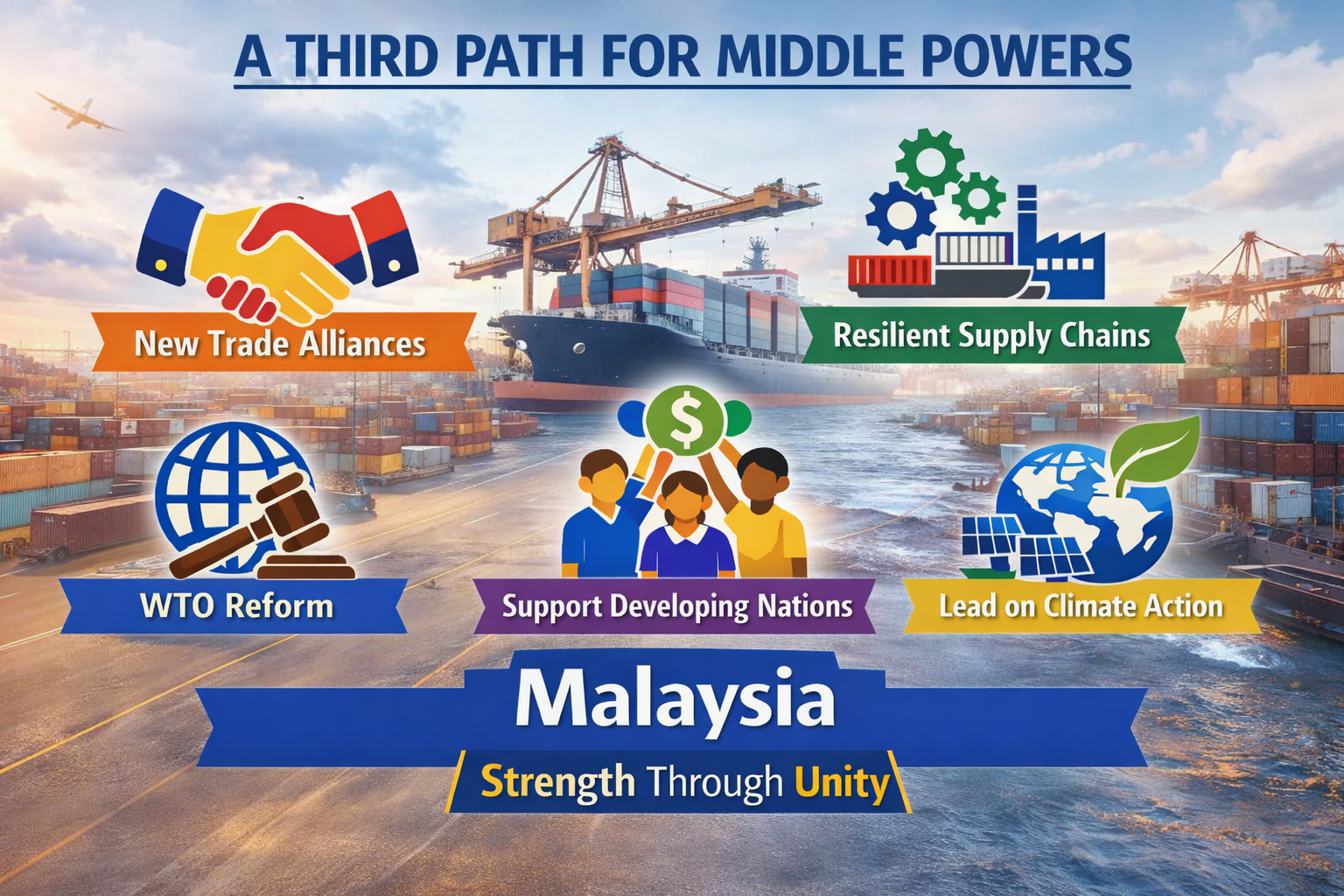
The first pillar must be trade. For Malaysia, diversification is an economic necessity. New and deeper free trade agreements among middle powers can reduce over-reliance on any single market.
Stronger links between regional blocs, including those in Asia and Europe, would widen access for Malaysian exporters while buffering us from sudden policy shocks in Washington or Beijing.
Second, supply chains must be rethought. As protectionism rises and industrial policy returns, middle powers share a common interest in building more resilient and autonomous production networks.
Malaysia’s experience in electronics, precision manufacturing, and increasingly digital services positions us well. The goal is not isolation, but balance.
Domestic and regional demand should matter more, so that shocks from one superpower do not ripple unchecked through our economy.
Third, the multilateral trading system needs urgent repair. Reforming the World Trade Organization is no longer an academic debate.
Without credible rules and dispute settlement, smaller and mid-sized economies lose their only real shield against coercion.
Middle powers must move together, not wait for permission, to propose and push reforms that keep trade fair and predictable.
Fourth, legitimacy matters. Any coalition of middle powers will fail if it ignores the needs of poorer and more vulnerable countries. Development finance gaps are widening as major donors pull back.
Filling those gaps is not charity. It is an investment in global stability. For Malaysia, which has long championed South-South cooperation, this is both a moral responsibility and a strategic interest.
Fifth, climate leadership cannot be postponed. With some major powers retreating from climate commitments, the burden shifts to those willing to act.
Malaysia knows the cost of inaction, from floods to heat stress. A renewed green agenda led by middle powers can drive technology, financing, and standards that make the transition affordable and credible.
Such a coalition does not need to look rigid or confrontational. Flexibility is its strength.
Different groups can cooperate on different issues, based on shared interests and values. But flexibility cannot mean silence when one member is unfairly targeted.
Economic pressure works only when others look away. Unity is the real deterrent.
Together, middle powers already command enormous influence. Europe remains an economic giant. India and Japan anchor Asia’s growth. Canada and Australia shape energy and resources.
Countries like Malaysia connect global supply chains and regional markets. Separately, each punches below its weight. Collectively, they can shape outcomes.
Yet this will require a rethink of habits and institutions, especially in Europe, which still struggles to act decisively despite its scale. Incomplete power can still lead, if it is willing to reform and commit.
The old international order is not returning. That much is clear. But disorder is not destiny.
For Malaysia, the choice is not between Washington and Beijing. The smarter choice is to work with others like us to widen the space in between, where rules matter, cooperation pays, and sovereignty is preserved through solidarity.
In a fractured world, the third path is no longer optional. It is the only path that makes sense.
Join the conversation
Comments
Login to join the conversation
No comments yet. Be the first to say something!
Join the Conversation
Log in or create an account to like, comment, and share posts.