We are missing the point on this hospital card issue
Listen to article
Newsenz Official
A multilingual hospital card has recently become the subject of public criticism, with some framing it as a potential threat to the status of the national language.
This reaction, however, overlooks both the facts of the incident and the broader context of how healthcare communication operates in Malaysia.
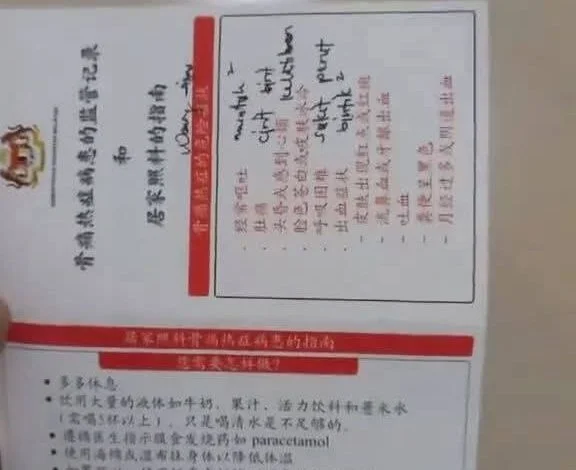
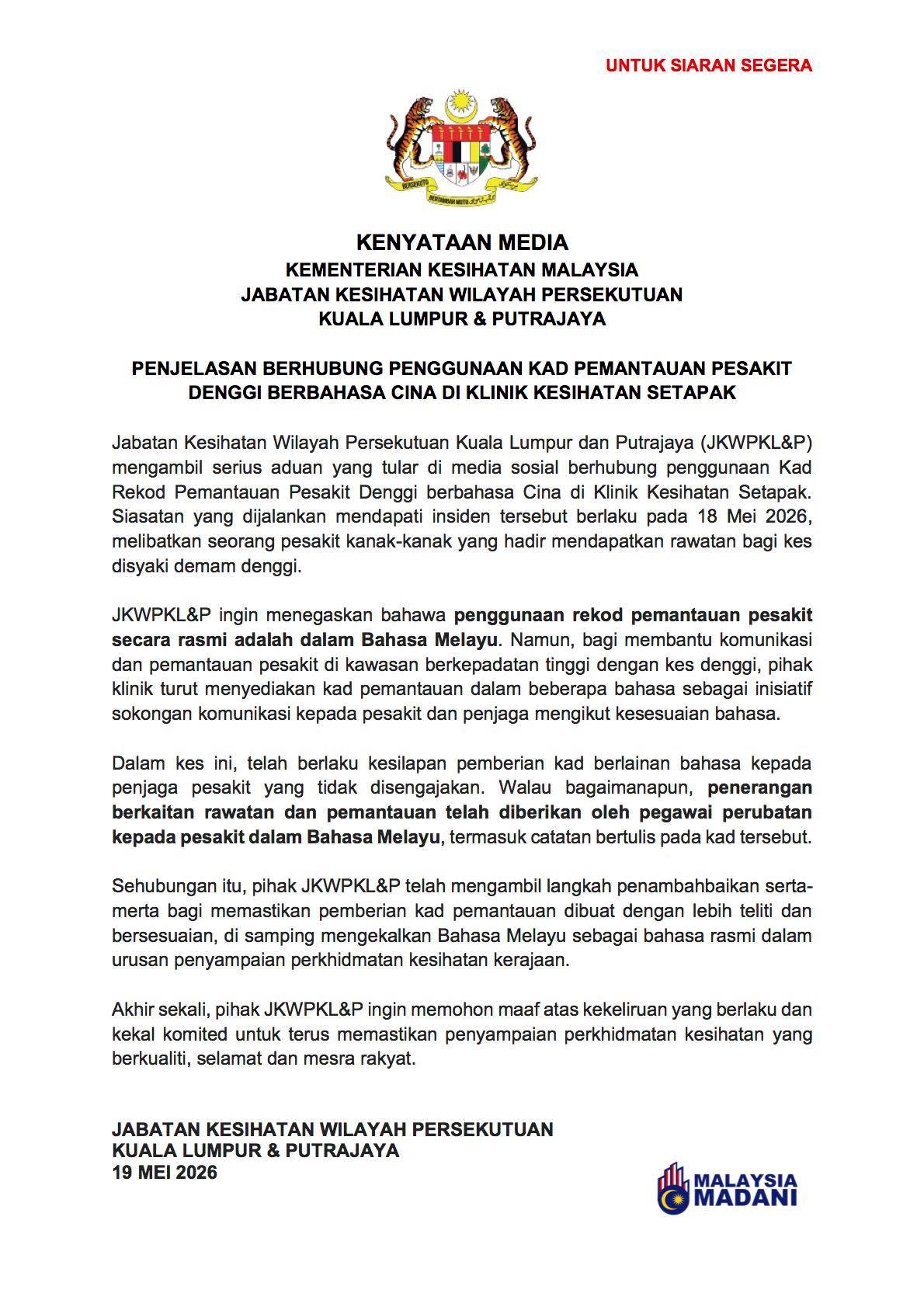
The Ministry of Health Malaysia has already clarified that Bahasa Malaysia remains the official language used in the case. The attending doctor communicated verbally in BM and the clinical notes were also recorded in BM. Photo: KKM (Facebook) The issue arose when, during peak operational hours, a Chinese-language dengue monitoring card was mistakenly handed to a patient’s guardian.
What is being discussed as a controversy is, in reality, an operational mistake rather than a policy shift.
The presence of multilingual materials in public healthcare is not a new development in Malaysia. For years, health brochures, posters, medication instructions and vaccination materials have been produced in multiple languages to support communication in a multilingual society.
This practice exists for a simple reason. Healthcare depends heavily on clarity, comprehension and timely understanding of medical instructions.
Malaysia’s linguistic diversity means that relying solely on one language in all patient-facing materials can create unnecessary barriers, particularly in fast-paced clinical environments where patients may already be stressed or unwell.
The use of supplementary materials in other languages does not replace or diminish the role of Bahasa Malaysia as the national language. The two functions operate in different spaces.
Bahasa Malaysia remains firmly established as the official language in government administration and healthcare documentation, while additional languages are used as practical tools to improve communication with patients.
In clinical settings, the priority is ensuring that patients and caregivers clearly understand medical advice, including symptoms to monitor, follow-up requirements and warning signs that require immediate attention. These are situations where miscommunication can have real consequences, making clarity more important than symbolic interpretation.
Questions are often raised about how individuals can reside in Malaysia for extended periods without being fluent in Bahasa Malaysia. However, healthcare environments are not appropriate spaces to reduce language use to a measure of personal capability or moral judgment. The focus in medicine is not linguistic evaluation but patient safety and comprehension.
Many countries have adopted similar approaches in their healthcare systems.
The United Kingdom, for example, provides interpreter services, translated medical documents, multilingual signage and structured language support within its National Health Service.
These measures are widely recognised as part of standard patient care rather than as challenges to the status of the national language. Their purpose is to ensure that patients understand medical information accurately and are able to engage effectively with treatment.
This reflects a broader principle in healthcare systems globally. Language accommodation in medical contexts is not about undermining national identity or official languages. It is about ensuring accessibility, reducing risk and improving the effectiveness of care delivery.
Within this context, it becomes clear that multilingual tools in hospitals and clinics should not be interpreted as symbolic threats.
Bahasa Malaysia remains fully intact in its official role, while supplementary languages serve a functional purpose in supporting communication between medical staff and patients.
There is, of course, a legitimate space for discussions on the role of Bahasa Malaysia in national identity, governance and civic life. These are important and ongoing conversations in any nation. However, not every administrative or clinical tool should be drawn into that debate.
A dengue monitoring card issued in a busy clinic, where healthcare workers are focused on managing patients and ensuring clear communication, is best understood as part of that practical system rather than as a political statement.
Join the conversation
Comments
Login to join the conversation
No comments yet. Be the first to say something!
Join the Conversation
Log in or create an account to like, comment, and share posts.