
26 May 2026
Malaysia
Your Genting Trip Just Got RM5 More Expensive. Here's Why.
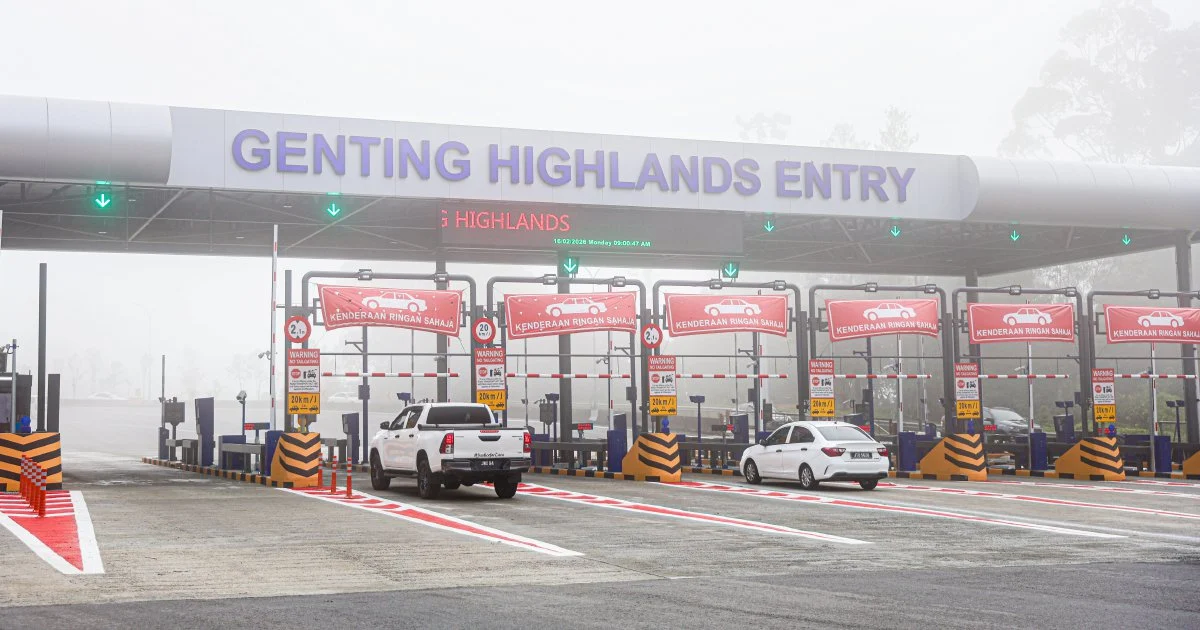
Want to go to Genting Highlands for some fresh air? Starting this Thursday, a trip up will cost you an extra RM5 just to drive to the peak.
Listen to article
Newsenz Official
Before you unleash an "arghhhhhh" over yet another road charge, there's something you need to know. That winding road up to Genting? It was never government-owned. Not a single sen of public money was spent to build it. So, who built it, who owns it, and who has been paying for its upkeep for nearly six decades? The answer to who should rightfully pay for the road begins with the extraordinary story of how it came to be.
How Genting Got There
Back in 1963, while working on a hydroelectric project in Cameron Highlands, Tan Sri Lim Goh Tong felt the invigorating cool mountain air and saw an opportunity. He envisioned a hill resort just 58 kilometres from Kuala Lumpur. After scouting the region, he set his sights on a then-remote peak called Gunung Ulu Kali. The land was steep, rugged, and considered by many to be impossible to develop.
Undeterred, Lim assembled a team and embarked on a nine-day, eight-night expedition to explore the mountain's dense jungles. They meticulously gathered data on the region's topography, drainage, and soil conditions, work that would prove essential for planning any future development. It was a visionary, almost foolhardy, bet on a patch of untamed highland that everyone else had written off.
Building the Road
With the land secured, the next monumental task was building a road to reach it. Construction of the access road from Genting Sempah to the peak of Gunung Ulu Kali began on 18 August 1965. It was a gruelling four-year project that involved carving a path through some of the country's most challenging mountainous terrain. On 31 March 1969, the road was finally completed. Then-Prime Minister Tunku Abdul Rahman laid the foundation stone for the resort's first hotel, marking a historic milestone. The crucial point is this: the government did not pay a single sen. Genting bore the entire cost.
The New Road Charge
Over the decades, something strange happened. The public began treating this private road as a public one. When landslides blocked the route, people instinctively blamed the government, even though the responsibility for repairs and maintenance rested entirely on Genting. After years of absorbing these rising costs alone, Genting announced last year that it would begin charging.
The charges, implemented by the authorised road operator Lingkaran Cekap Sdn Bhd (LCSB), will be collected at two entry points: Genting Sempah and the Gohtong Jaya roundabout. Starting Thursday, 28 May 2026, the fees are as follows:
Cars and vans: RM5 per entry
Taxis: RM3.30 per entry
Buses: RM5 per entry
Medium lorries: RM15 per entry
Heavy lorries: RM25 per entry
Motorcycles and emergency vehicles are fully exempt. There are also special provisions for permanent residents, who will be offered a preferential rate starting 28 June, and for civil servants working at government institutions on the hill, whose private vehicles will be exempt.
The Legal Greyline: A Private Road, Not a Public Toll
The first point of contention is the government's legal position. Deputy Works Minister Datuk Seri Ahmad Maslan has clearly stated that the charge imposed by Genting cannot be classified as a "toll". Because the road is private property, the federal government, through the Works Ministry and the Malaysian Highway Authority, has no jurisdiction over it.
"It is not a toll. The road belongs to them (Genting). They are responsible for the maintenance, the slopes, and the road quality," Ahmad Maslan explained. He further noted that using the term "toll" could confuse the public into thinking it's a government project, as Malaysia already has 33 official toll concessionaires. Legally, Genting is on solid ground. As the private landowner, it has the right to impose a fee for access to its property.
The Fairness Greyline: A Public Good or a Private Asset?
The second debate is a moral one, splitting public opinion right down the middle.
Supporters argue that the "user pays" principle is fair. The 24km road is incredibly expensive to maintain. Its steep terrain is prone to frequent landslides, with a single slope repair project costing around RM19 million. As one Facebook user argued, "to be honest, blame all those wannabe racers who keep crashing at Genting," suggesting the reckless drivers are a key reason for the high costs. Others contend that if you can afford the hotels and the casino, an extra RM5 is a negligible expense.
Critics, however, see this as a cash grab. They point out that a family on a budget already pays highway tolls just to get to the Gombak exit before even reaching the Genting road. "Expensive parking fees already deter people from going there. Now charging toll," lamented one Facebook user. Many argue the charge unfairly burdens casual visitors who simply want to enjoy the cool mountain air or stay at Airbnbs that are not even owned by Genting, asking why they should have to pay for a road that leads to a resort they're not using.
Conclusion: A Precedent Set
So, is the RM5 charge justified? Legally, the answer is clear. The road belongs to Genting, and the company has shouldered the immense financial burden of its construction and maintenance for decades. With the government having no jurisdiction, Genting is well within its rights to impose a "vehicle charge" on its private property.
But morally, the situation is murkier. Genting Highlands has become a public getaway for millions of Malaysians from all walks of life. To suddenly erect a paywall on a mountain route that has been used freely for generations blurs the line between legitimate cost recovery and corporate opportunism.
Whether you support the charge or oppose it, the implementation of this new fee marks a significant precedent in Malaysia. It confirms that a private company can, with the proper land titles, claim ownership over a vital access route and charge the public for its use. The debate over Genting's "toll" is not just about RM5. It's about who ultimately controls access to Malaysia's public spaces.
Join the conversation
Comments
Login to join the conversation
No comments yet. Be the first to say something!