
29 May 2026
Malaysia
UMNO's Double Act: Collapse or Calculated Chaos?
Why Zahid's silent tolerance of Akmal's anti-DAP firebrand politics might be the only thing keeping Malaysia's oldest party from imploding
Listen to article
Newsenz Official
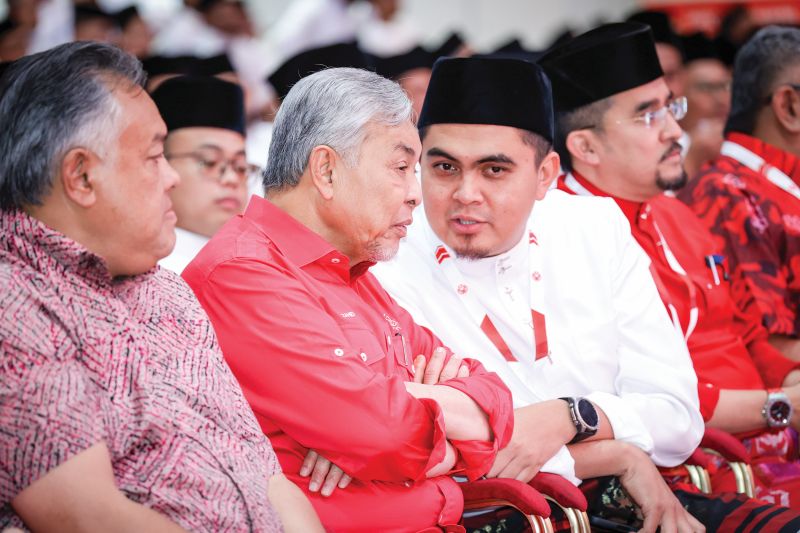
On the surface, UMNO looks like a party eating itself alive from within. Youth chief Muhamad Akmal Saleh has spent months launching rhetorical grenades at the Unity Government's most sensitive fault lines—attacking DAP, stoking Malay nationalist grievances, hinting that UMNO should reconsider its partnership with Pakatan Harapan, and generally behaving like a man who either didn't get the coalition memo or actively wants to tear it up.
And yet, party president Ahmad Zahid Hamidi watches from the sidelines, offering little more than the occasional mild rebuke. No serious discipline. No public dressing down. No swift reminder of who controls UMNO's machinery.
To casual observers, this looks like weakness. Evidence of a decaying central authority. Proof that UMNO is fragmenting into warring factions, with Zahid reduced to a caretaker leader unable to control his own youth wing.
But that reading misses something crucial. What if Zahid isn't failing to control Akmal—what if he's using him?
The Two-Front War
UMNO currently faces an existential contradiction that would fracture any political party. On one side, it needs the Unity Government. Desperately. Without federal power, without ministerial positions, without the flow of resources and influence that comes from being part of the ruling coalition, UMNO becomes a ghost. The 2022 election proved that. The party's worst-ever result was a direct consequence of Malay voters abandoning it for Perikatan Nasional. Staying in government with Anwar Ibrahim's Pakatan Harapan is not ideal for UMNO's traditionalists—but leaving would be suicide.
On the other side, UMNO's grassroots still seethe with distrust toward DAP. Thirty years of racialized rhetoric cannot be undone by a single coalition agreement. A huge chunk of UMNO's base views the Unity Government as a betrayal, Anwar as an untrustworthy reformist, and DAP as the same existential threat it has always been. If Zahid went full "moderate coalition partner," if he genuinely embraced PH as brothers rather than transactional allies, those voters would flee permanently to PN and PAS.
This is the trap. Move too far toward Anwar, lose the base. Move too far toward the base, lose the government.
Enter Akmal, The Necessary Agitator
This is where Akmal becomes not a liability but an asset. He plays the role Zahid cannot play. He reassures the anxious Malay heartland that UMNO hasn't gone soft. He keeps nationalist rhetoric alive without forcing Zahid to personally endorse it. He absorbs the grassroots anger that would otherwise be directed at party leadership. He is, in effect, UMNO's licensed provocateur—the "bad cop" who allows Zahid to govern from the center while the youth wing agitates on the right flank.
This is not unprecedented. Political parties across the world maintain such dynamics. The ruling party needs someone to say the quiet parts out loud, to keep the base energized, to provide ideological cover for the leadership's more pragmatic compromises. In Japan's LDP, younger nationalists play this role. In India's BJP, state-level firebrands often say what Modi cannot. In UMNO's own history, Mahathir tolerated certain provocations while maintaining firm control of the centre.
But here's the difference: in those systems, everyone understands the game. The leader signals, implicitly, where the boundaries are. The agitator pushes but does not break. The centre holds.
In UMNO's case, the signals are alarmingly unclear.
The Cost of Contradiction
The problem with Zahid's apparent strategy is that it creates ideological whiplash. One week, Zahid praises the Unity Government's cooperation and stability. The next, Akmal is accusing DAP of undermining Malay rights and suggesting UMNO should reconsider its position. Party officials speak about "grand Malay collaboration" while sitting in a multi-ethnic coalition. Voters are left genuinely confused about what UMNO actually stands for.
Is UMNO a moderate coalition partner committed to Anwar's reform agenda? Is it a Malay nationalist party still fighting the old battles? Is it both? Can it be both?
The evidence suggests not. Internal party surveys and private admissions from UMNO leaders have acknowledged that the party's support remains fragile, its identity fractured, its base alienated. Akmal's rising popularity may actually indicate that the grassroots sees the leadership as disconnected—that the youth chief's provocations resonate precisely because they feel authentic in a way that Zahid's coalition-friendly statements do not.
If that is true, then Zahid is not controlling Akmal. Akmal is channeling a genuine rebellion that Zahid cannot suppress without triggering an internal revolt. And that looks less like strategy and more like a leader managing decline.
The Uncomfortable Conclusion
So is UMNO collapsing or performing theatre? The most honest answer is: both.
The theatre is real. Zahid almost certainly understands the utility of keeping a firebrand like Akmal operational. The youth chief provides valuable political cover, absorbs grassroots discontent, and prevents an outright exodus to PN. There is intentionality here, even if it goes unspoken.
But the collapse is also real. Because a party that requires this level of internal contradiction—that must publicly signal two completely different messages to two completely different audiences—is not a healthy party. It is a party surviving on borrowed time and strategic ambiguity. And strategic ambiguity has a shelf life.
At some point, UMNO will have to choose. Fully commit to the Unity Government and risk losing its conservative base. Or pivot back toward Malay nationalism and abandon the coalition that keeps it relevant. The current arrangement—Zahid winking at Akmal's provocations while shaking Anwar's hand—cannot hold forever.
Until that choice is made, UMNO will continue to look like a party tearing itself apart. Whether that tearing is collapse or choreography depends entirely on whether Zahid can keep the show running.
Join the conversation
Comments
Login to join the conversation
No comments yet. Be the first to say something!