
29 May 2026
Society
The Empire of Malice: How Nestlé Built a Fortune on Infant Graves and Stolen Water
The Swiss giant's history is not one of corporate missteps—but of deliberate, profit-driven cruelty
Newsenz Official
There is an uncomfortable question at the heart of modern capitalism: how much suffering is a fair trade for quarterly growth? For most companies, this remains a philosophical abstraction. For Nestlé, it has been operational strategy for over half a century.
The world's largest food company has spent decades perfecting a business model that would make a Victorian factory owner blush. Aggressive marketing of baby formula to illiterate mothers in developing countries, resulting in an estimated 10.9 million excess infant deaths between 1960 and 2015. Adding up to 7.5 grams of sugar per serving to baby cereal sold in Africa while selling the identical product sugar-free in Europe. Pumping hundreds of millions of gallons of water from drought-stricken communities and paying virtually nothing for it. Sourcing cocoa from plantations that enslave children.
This is not a company that stumbles into scandal. This is a company that has institutionalized predation as a core competency.
The Formula for Death
The story begins in the 1970s, when Nestlé identified a lucrative new market: the wombs of poor mothers. As breastfeeding rates declined in wealthy countries, formula sales stagnated. So Nestlé turned to the developing world, where birth rates were high and regulatory oversight was low.
Their marketing strategy was ingeniously evil. The company dispatched "milk nurses"—saleswomen dressed in nursing uniforms—to maternity wards across Africa, Asia, and Latin America. They provided free formula samples to hospitals, knowing that once a mother's milk supply dried up after a few days of bottle feeding, she would become a lifelong customer. They paid doctors and nurses to recommend their brands, turning medical professionals into unwitting salespeople. They saturated communities with advertisements promising "healthy, chubby babies" through "modern infant nutrition".
The problem? Most of these mothers could not read instructions, lacked access to clean water, and could not afford sufficient formula. Mixing powder with contaminated water introduced deadly pathogens. Diluting formula to stretch limited funds meant babies starved slowly. A landmark 2024 study found that Nestlé's entry into low- and middle-income formula markets caused approximately 212,000 infant deaths per year at the scandal's peak in 1981. The cumulative toll between 1960 and 2015: an estimated 10.9 million excess infant deaths.
When activists published a pamphlet titled "Nestlé Kills Babies," the company's response was not reform but litigation. When the World Health Assembly adopted the International Code of Marketing of Breast-milk Substitutes in 1981, Nestlé initially refused to comply, endorsing only the "principle" while continuing its practices.
This was not incompetence. It was calculation. Each dead infant was a line item. Each grieving mother was a suppressed data point. And the balance sheet remained exceptionally healthy.
The Sugar Lie: A Double Standard for a Double World
If the formula scandal was Nestlé's original sin, the baby food sugar controversy proves the company has learned nothing in fifty years.
In April 2024, Swiss investigative organization Public Eye dropped a bombshell. Laboratory analysis revealed that Nestlé was adding significant amounts of sugar to its Cerelac baby cereal sold in lower-income countries, while selling the exact same product with zero added sugar in Britain and Germany. In the Philippines, Cerelac contained 7.3 grams of added sugar per serving. In Thailand and Ethiopia, up to 6 grams. Across the Global South, an average of 4 grams per serving—roughly one sugar cube. Meanwhile, Swiss babies ate sugar-free. German babies ate sugar-free. British babies ate sugar-free.
The company's defense was as revealing as it was repellent. Nestlé claimed the variations reflected "regulations and availability of local ingredients". This is nonsense. Sugar is cheaper than the fruit and vegetable powders used in European versions. The real explanation is that developing countries have weaker regulations, poorer consumer advocacy, and less capacity for outrage. Nestlé calculated that African and Asian babies were worth less than European babies.
Then came the 2025 follow-up investigation, and the story grew even darker. Public Eye analyzed nearly 100 Cerelac products across 20 African countries. Over 90% contained added sugar. The average serving contained nearly 6 grams of added sugar—50% more than the 2024 findings and twice the level detected in India. The worst product, sold in Kenya for six-month-old babies, contained 7.5 grams per serving, equivalent to almost two sugar cubes.
Consider what this means. The World Health Organization explicitly advises no added sugars in any food for children under three. Nestlé's own Brazilian website states that it is "ideal to avoid eating added sugar in childhood". Yet the same corporation that markets sugar-free products to Swiss mothers is feeding sugar cubes to Kenyan infants.
The health consequences are not hypothetical. Early sugar exposure creates lifelong preferences for sweet foods, driving obesity, insulin resistance, and metabolic disease. Childhood obesity in Africa has nearly doubled since 1990, and the continent projects a 250% increase by 2050. Nestlé's sugar habit is a public health disaster in slow motion. And the company knows it. It simply does not care.
As 20 African civil society organizations wrote in an open letter to Nestlé's CEO: "All babies have an equal right to healthy nutrition—regardless of their nationality or skin colour. All babies are equal. Do the right thing. The world is watching".
Nestlé's response? Denial. Attack the report's credibility. And promise to introduce sugar-free variants "by the end of 2025"—a half-measure that African organizations have dismissed as wholly inadequate.
Water Thieves, Not Water Stewards
The pattern extends beyond baby food. Nestlé has built a parallel empire in bottled water by treating a public resource as private property.
In Michigan, while the residents of Flint were drinking poison from lead-contaminated pipes, Nestlé pumped 200 gallons of fresh water out of the ground every single minute. In exchange for extracting over 130 million gallons of water annually from northwestern Michigan, Nestlé paid just $200 per year in fees. That is not commerce. That is theft with a receipt.
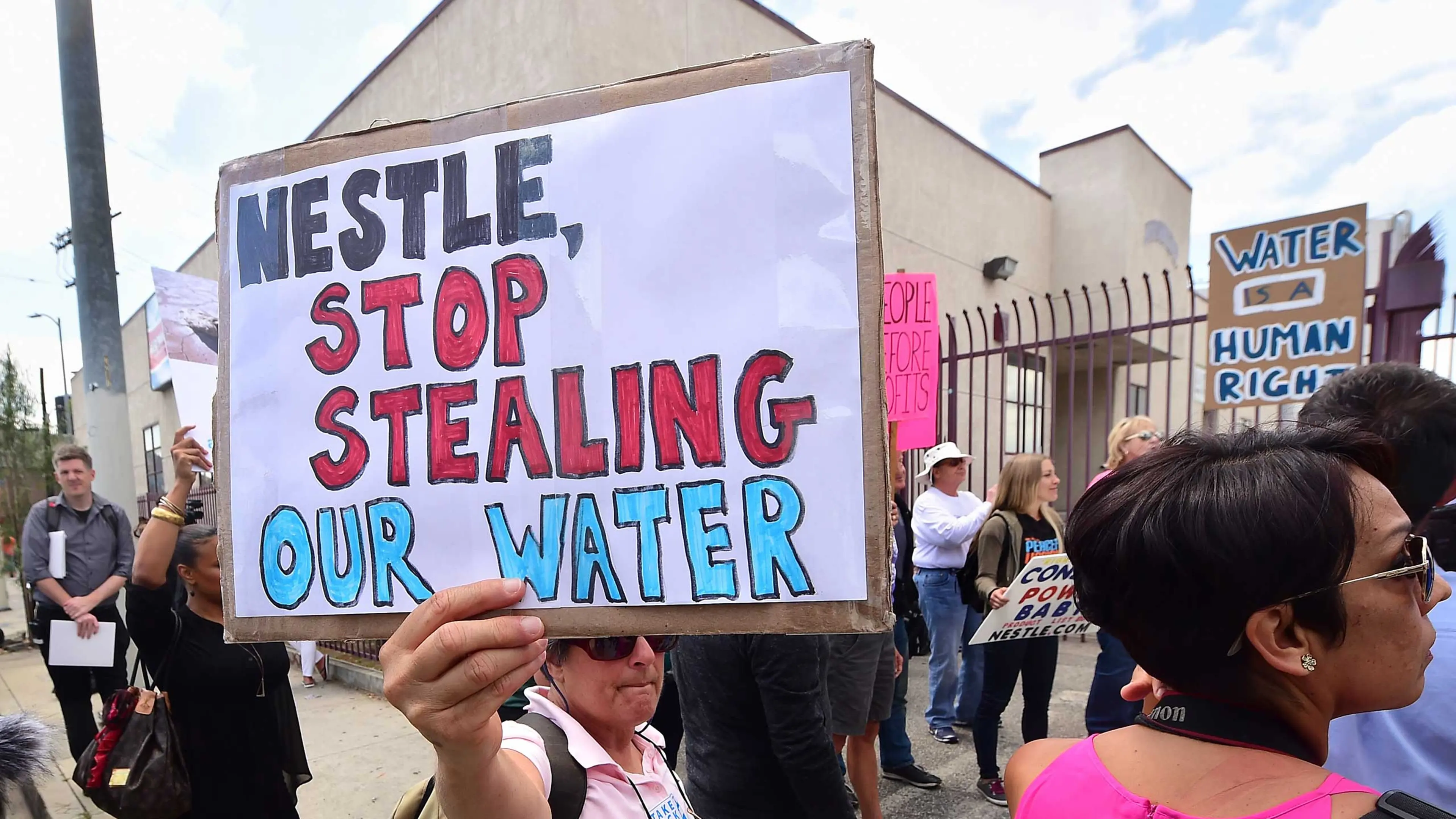
In California, during the state's most severe drought between 2011 and 2015, Nestlé was siphoning millions of gallons from Strawberry Creek in the San Bernardino National Forest, bottling it as Arrowhead brand water. An investigation found the company was drawing 58 million gallons annually—25 times the 2.3 million gallons it could validly claim rights to. When asked on public radio whether Nestlé would reduce extraction, the CEO of Nestlé Waters North America replied, "Absolutely not. In fact, if I could increase it, I would".
This is not ambiguous. This is not a regulatory gray area. This is the CEO of a multinational corporation openly stating his intention to steal more water during a drought. The only surprising thing is that anyone still pretends to be surprised.
The Cocoa Chain of Misery
The pattern extends again to chocolate. Nestlé sources significant quantities of cocoa from Ivory Coast, where child labor and modern slavery are endemic. In July 2025, a U.S. federal appeals court dismissed a class action lawsuit brought by eight Malian citizens who had been trafficked as children and forced to work on Ivorian cocoa farms. The court ruled that the plaintiffs could not prove a direct connection between their specific plantations and the chocolate companies' supply chains.
Note what happened here. The court did not rule that the children were not enslaved. It ruled that the legal architecture of global supply chains had been deliberately constructed to insulate buyers from accountability. Nestlé did not have to prove it was innocent. It only had to prove that the system it helped design made proving guilt impossible.
The Uncomfortable Conclusion
Nestlé is not a company that has made mistakes. It is a company that has perfected a formula: identify a vulnerable population, extract maximum value, externalize every possible cost onto that population's health and environment, and deploy armies of lawyers and public relations specialists to ensure nothing changes.
The formula scandal killed millions. The sugar double standard is setting a continent up for obesity epidemic. The water theft drains communities during drought. The cocoa supply chain relies on child labor. And through it all, Nestlé issues press releases denying "double standards" and promising to "do better next time."
Here is the truth: there is no next time. There have been fifty years of next times. In 1974, activists warned about formula deaths. In 1981, the WHO adopted its marketing code. In 1984, a seven-year boycott ended with Nestlé making promises it never kept. In 2024 and 2025, the sugar scandal erupted. The pattern is identical. The company does not reform. It waits. It denies. It obfuscates. And then it does it again.
Nestlé's business model is not broken. It is working exactly as designed. The question is not whether the company will change. It will not. The question is whether consumers, regulators, and investors will finally decide that 10.9 million dead children is enough.
Join the conversation
Comments
Login to join the conversation
No comments yet. Be the first to say something!